
From Problems to New Possibilities: Human Capacities to Navigate a Complex World
Several months ago, I was at a conference when someone made a point that stayed with me: “As humans, we need a new operating system.” There was almost a desperation to it. In his eyes, the ways of working we'd inherited were no longer a satisfactory answer to the problems we face today. He wasn't talking about technology.
I've been thinking about and working on this shift for years. Hearing someone else say it out loud stayed with me, enough to write this article. What I haven't shared with you is what changes and what's possible when it does.
Across organizations of many shapes and sizes, I keep hearing variations of the same conversation.
“Our people aren’t creative enough.”
“Our teams work in silos.”
“I’m expected to have the answer.”
“I’m solving more problems than ever, yet our biggest challenges never seem to get solved.”
“The strategy keeps changing, but my work remains the same.”
They sound like different problems. But I don't think they are. I think they're symptoms of a familiar operating system—the underlying logic that shapes how most organizations approach problems.
In my last article, What if Your Problem Isn't the Problem?, I ended with a question: What is changing beneath the surface, and why? That question is where this article begins.
It should be no surprise that AI is forcing a conversation about what work now asks of us. But AI is only part of a much larger shift in our environment today. Economic volatility, geopolitical instability, and eroding trust, to name a few, are challenging the conditions in which organizations operate and making complexity even harder to ignore.
And yet, most conversations about preparing for the future focus on new tools, skills, and capabilities people will need to keep up with the pace of change. Far fewer ask what human capacities make those capabilities possible in the first place.
Many of the systems we inherited were shaped by a worldview that evolved from the Enlightenment through the Industrial Age. It taught us to understand problems by breaking them into parts, analyzing them, and optimizing each part independently. Over time, these patterns of thinking have become so familiar that a way of solving problems has become the way of solving problems. We rarely question it.
When problems can be broken into relatively independent parts, that logic works remarkably well:
Problem → Analysis → Solution
But complex problem solving isn't linear.
Much of our effort, however, has been to improve what we already have. By doing so, we've inadvertently mistaken iteration for transformation. While iteration makes the existing system more efficient, transformation changes the operating system itself.
When it comes to complexity, keep iterating on an operating system built for a different time and you can become exceptionally good at ________. I'll let you fill that in.
But change the operating system, and what becomes possible changes with it:
Default
Problem → Analysis → Solution
↓
Today
Problem → 1AU OS → New Patterns → New Possibilities
This is the shift.
What the moment asks of us
Our inherited ways of thinking don't just influence how we solve problems. They influence what we're able to see.
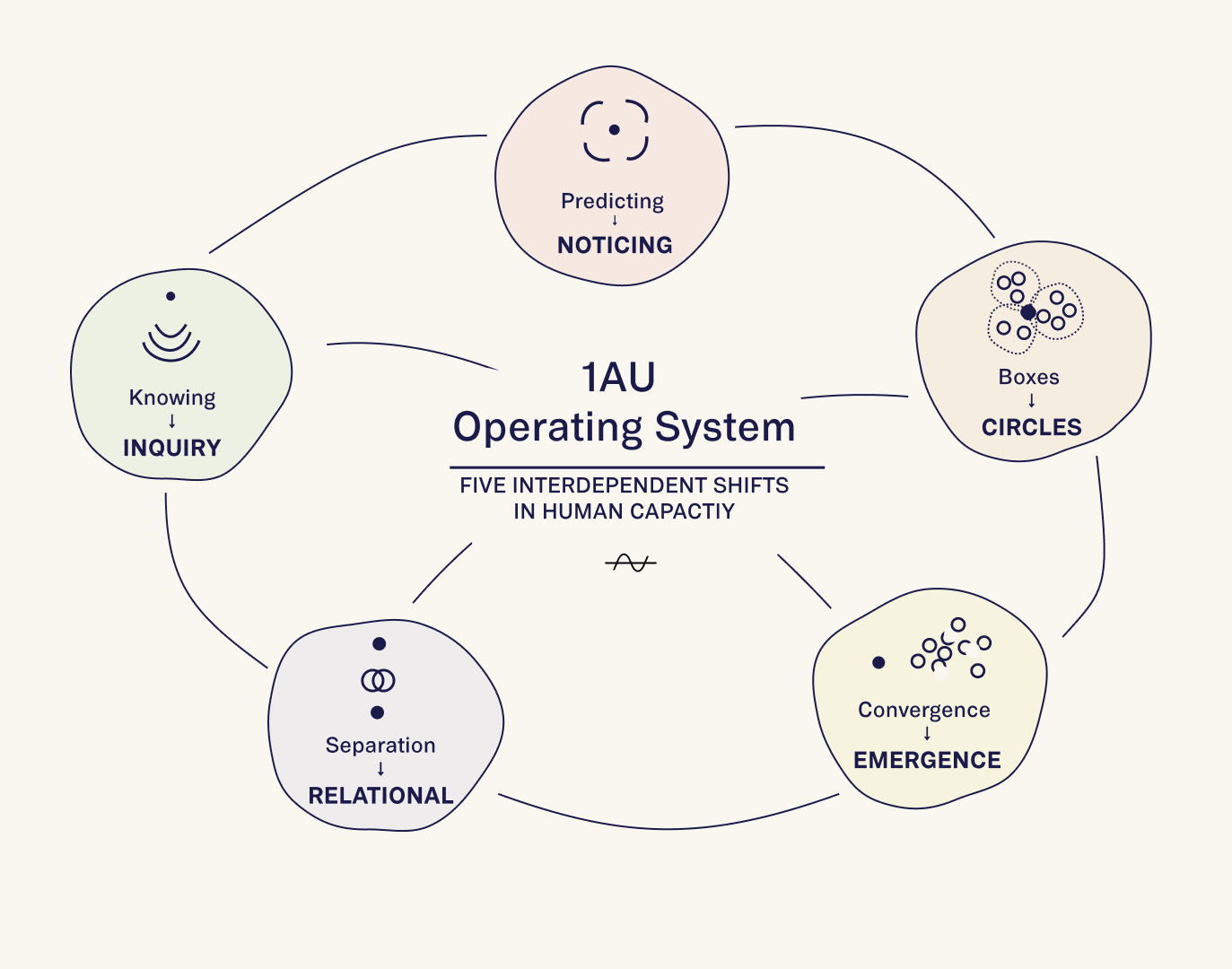
Figure 1. The 1AU Operating System
At the heart of the 1AU Operating System are five interdependent shifts in how we perceive, think, understand, relate, and create. Together, they cultivate the human capacities we need to approach complexity. The 1AU OS isn't simply a different way of solving problems. It's a different way of experiencing them.
These shifts aren't about replacing one way of operating with another. Our inherited ways still have value. The problem arises when they remain our defaults regardless of the problem in front of us.
This isn't simply about how people need to change. We all work in environments that influence how we operate and solve problems. However, expecting people to work differently without changing those conditions creates a contradiction.
The five shifts change both how we operate and how we experience the work. As these shifts change how we work, we begin to see patterns we couldn't see before—and with them, new possibilities.
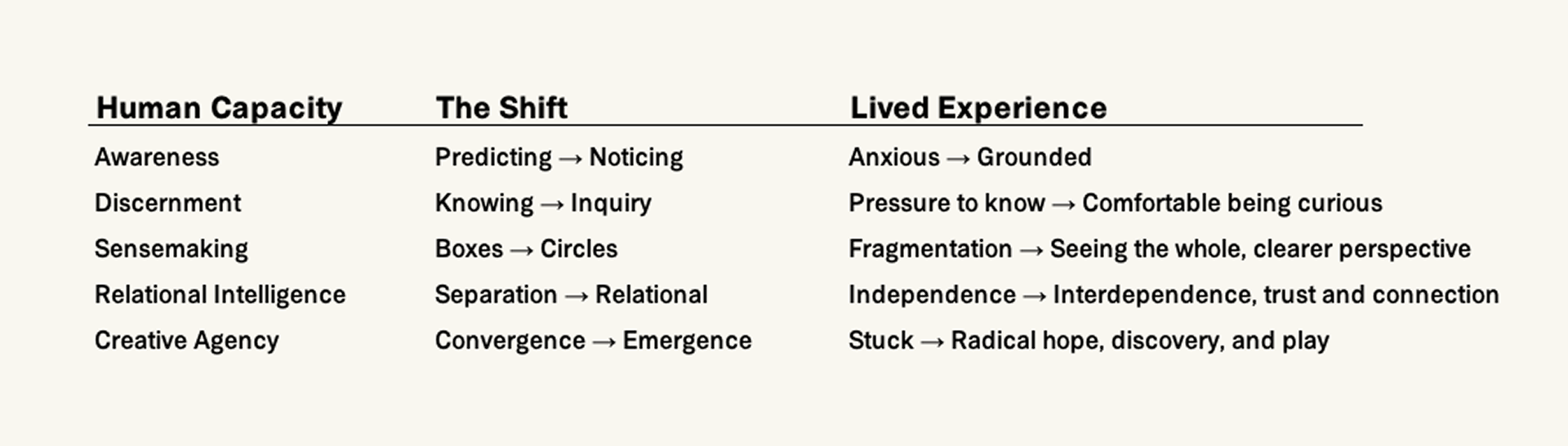
Figure 2: The five shifts of the 1AU Operating System and their lived experience
Can you see the shift?
If we don't change how we work, we're likely to keep creating variations of what we've created before.
What becomes possible
The five shifts won't tell us exactly what comes next. That's not their purpose. In complexity, neither the problem nor the solution is always as clear as it first appears.
Causes and effects are intertwined. What happens in one part of a system can change another. And what looks like the problem may be a symptom of something happening somewhere else. Working with complexity requires us to stay open long enough to notice those relationships.
Unlike the traditional Problem → Analysis → Solution model, we don't begin with the assumption that we need to converge on a solution. The 1AU OS creates the conditions for creativity to flourish and opens up new possibilities for outcomes we hadn't previously imagined.
That's where the progression we started earlier continues:
New Possibilities → New Ways to Act → Adapt by Design
That changes how we work with complexity. Instead of reducing it to something more manageable, we become better equipped to work within it.
We can see this in how we frame everyday organizational problems.
I've been in a number of conversations lately about a growing tension between Gen Z and the workplace they're entering. We often frame it as a question of how Gen Z needs to adapt. Perhaps the question isn't only how Gen Z needs to adapt to the workplace, but how the workplace needs to adapt to them. Before we answer either, we may need to question the assumptions underneath both.
Many real-world problems work this way: our focus on finding a solution can keep us from seeing the relationships and possibilities surrounding the problem.
And too often, when we talk about innovation, we mean product innovation. But what if the thing that needs reinventing isn't the product? It may be how we organize, work together, or understand the problem itself.
Complexity also means living with uncertainty. Ironically, the more uncertain the world becomes, the more we tend to cling to certainty at exactly the wrong moment. We want clearer answers, tighter plans, greater control, and confidence about where we're going. It's an understandable response. But it pulls us back toward the very ways of operating that uncertainty is exposing the limits of.
There are stakes to this.
An organization can be competent, rational, and successful while becoming increasingly misaligned with the world around it. The assumptions that produced yesterday's success can continue to work even as the conditions underneath them begin to change.
That's what makes the inherited operating system so difficult to leave. It can keep working right up until it doesn't.
The greatest risk may not be getting the future wrong. It's becoming exceptionally good at operating in a reality that no longer exists.
The opportunity is to change while there's still room to choose—before uncertainty chooses for us.
That's what it means to adapt by design.
That's the work of the 1AU Operating System.
Let that sit.
-Nilesh Morar, 1AU